
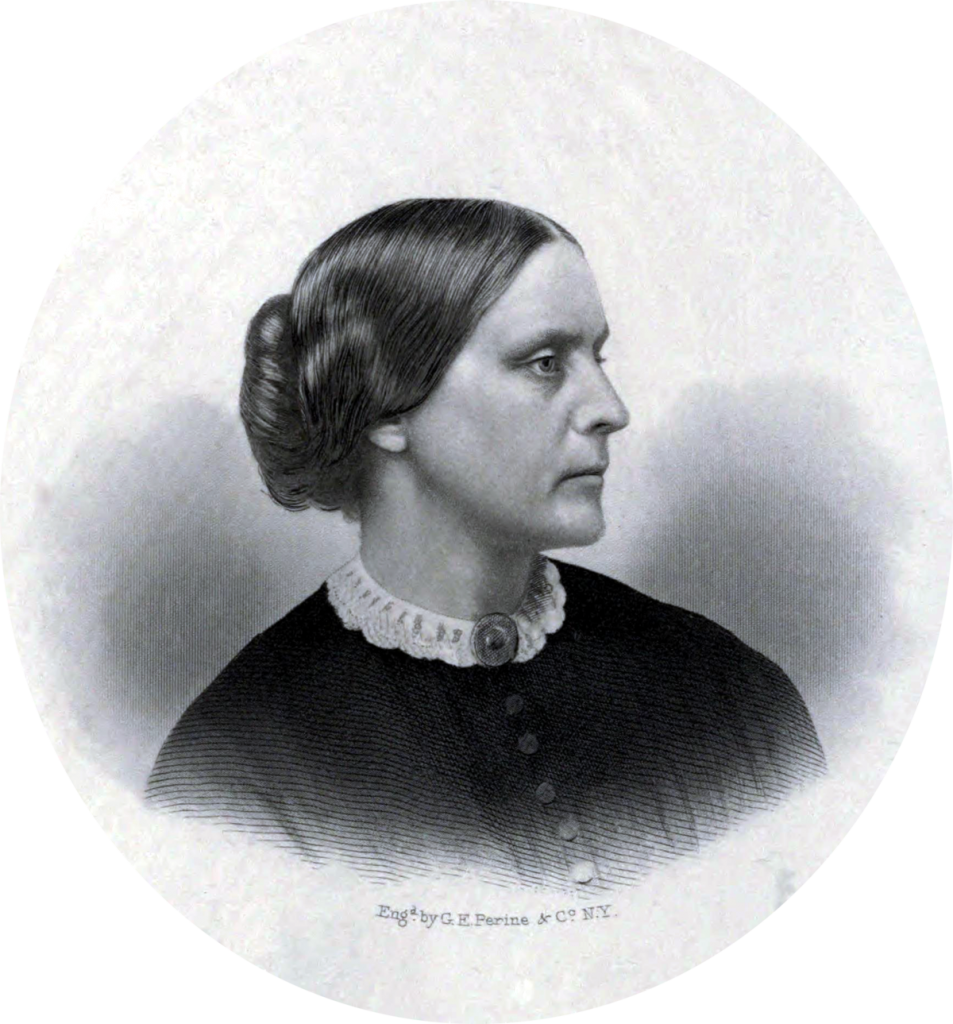
Susan B. Anthony (1820-1906) is one the most consequential figures in the history of the United States. Known as the Great Reformer, she is the most identifiable figure of the Suffragist movement which led to the passage of the 19th Amendment in 1920, enshrining the right of women to vote. Anthony also worked on behalf of numerous other causes, including abolition, labor, education, as well as other aspects of women’s rights, such as property rights, dress reform, and more.
Expand the topics below for a brief introduction to Anthony’s life and work.
Timeline
1820 – Susan Brownell Anthony is born on February 15 in Adams, Massachusetts, the second of seven children.
1826 – The Anthony family moves to Battenville, New York.
1838 – Daniel Anthony takes daughters Susan and Guelma out of school. The 1837 depression causes him to declare bankruptcy and the family loses the Battenville house.
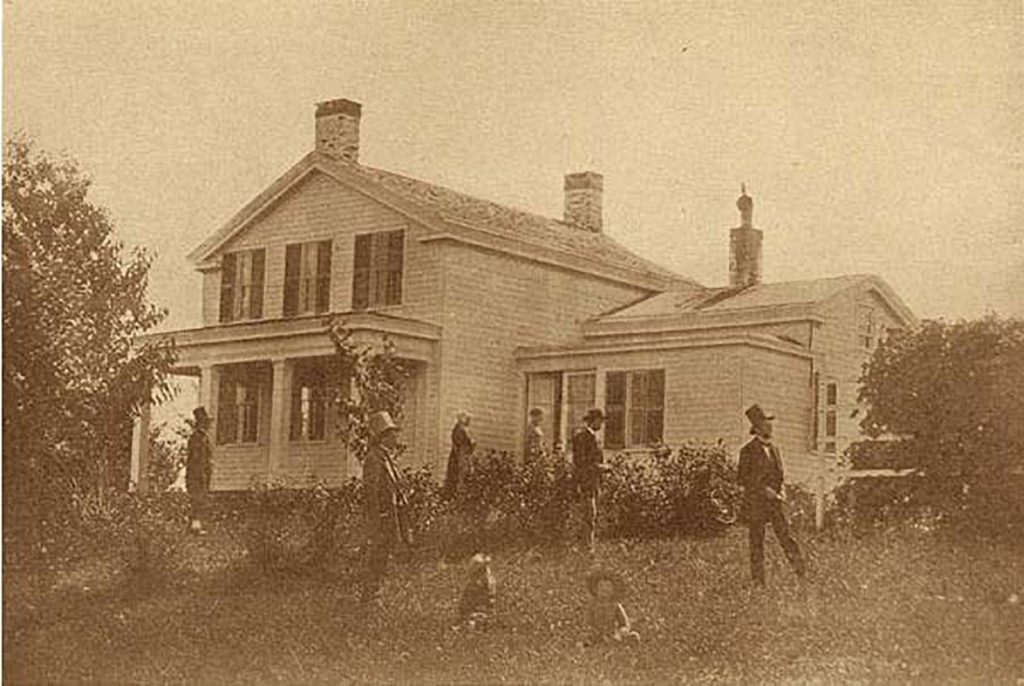
1845 – The Anthony family moves to Rochester, New York, on the Erie Canal. Their farm on what is now Brooks Avenue becomes a meeting-place for anti-slavery activists, including Frederick Douglass.
1846 – Susan B. Anthony begins teaching at Canajoharie Academy for a yearly salary of $110.
1851 – Susan B. Anthony travels to the anti-slavery convention in Seneca Falls, New York. She visits Amelia Bloomer, hears William Lloyd Garrison and George Thompson, and meets Elizabeth Cady Stanton.
1852 – Anthony attends a New York State convention of Sons of Temperance and is told to “listen and learn,” which goes against her Quaker upbringing. She attends her first women’s rights convention.
1854 – Anthony circulates petitions for married women’s property rights and woman suffrage. She is refused permission to speak at the Capitol and Smithsonian in Washington. She begins her New York State campaign for woman suffrage in Mayville, Chautauqua County, speaking and traveling alone.
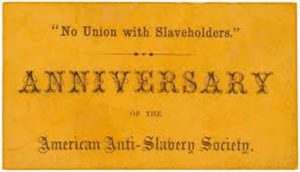
1856 – Anthony becomes agent for the American Anti-Slavery Society.
1857 – At a New York State Teachers’ Convention in Binghamton Anthony calls for education for women and Blacks.
1861 – Anthony conducts anti-slavery campaign from Buffalo to Albany-“No Union with Slaveholders. No Compromise.”
1863 – Anthony and Stanton write the “Appeal to the Women of the Republic.”
1868 – Anthony begins publication of The Revolution and forms Working Women’s Associations for women in the publishing and garment trades.
1869 – Anthony calls the first Woman Suffrage Convention in Washington D.C.
1872 – Anthony is arrested for voting in the front parlor of 7 Madison Street (now 17 Madison) on November 18 and is indicted in Albany. She continues to lecture and attend conventions.
1873 – Anthony is tried and fined $100 with costs after the judge ordered the jury to find her guilty. Anthony refuses to pay but is not imprisoned so cannot appeal the verdict.
1881 – Anthony, Stanton, and Matilda Joslin Gage publish Volume I of the History of Woman Suffrage, followed by Volumes II, III and IV in 1882, 1885 and 1902.
1898 – The Life and Work of Susan B. Anthony, A Story of the Evolution of the Status of Women is published. Anthony establishes a press bureau to feed articles on woman suffrage to the national and local press.
1900 – Anthony pledges the cash value of her life insurance to meet the University of Rochester’s financial demands for the admission of women.
1902 – Anthony delivers the keynote address to the New York State Nurses Convention, advocating for the standardization of training and state registration of nurses. The Nurses Practice Act is passed in 1903.
1905 – Anthony meets with President Theodore Roosevelt in Washington, D.C., about submitting a suffrage amendment to Congress.
1906 – Anthony attends suffrage hearings in Washington, D.C., She gives her “Failure is Impossible” speech at her 86th birthday celebration. Anthony dies at her Madison Street home on March 13.
1920 – The 19th Amendment to the U.S. Constitution, also known as the Susan B. Anthony amendment, grants the right to vote to all U.S. women over 21.
Quotations
Woman must not depend upon the protection of man, but must be taught to protect herself.
—Speech in San Francisco (July 1871)
If I could live another century! I do so want to see the fruition of the work for women in the past century. There is so much yet to be done, I see so many things I would like to do and say, but I must leave it for the younger generation. We old fighters have prepared the way, and it is easier than it was fifty years ago when I first got into the harness. The young blood, fresh with enthusiasm and with all the enlightenment of the twentieth century, must carry on the work.
—The Democrat and Chronicle, August 28th, 1902; quoted by Lynn Sherr, Failure is Impossible, 329
A short time thereafter Miss Anthony, Mrs. Stanton, Mr. Phillips and Mr. Tilton were in the Standard office discussing the work. Mr. Phillips argued that the time was ripe for striking the word ‘white’ out of the New York constitution, at it’s coming convention, but not striking out ‘male.’ Mr. Tilton supported him, in direct contradiction to all he had so warmly advocated only a few weeks before, and said what the women should do was canvass the State with speeches and petitions for the enfranchisement of the negro, leaving that of the women to come afterward, presumably twenty years later, when their would be a revision of the constitution. Mrs. Stanton, entirely overcome by the eloquence of these two gifted men, acquiesced in all they said: but Miss Anthony, who never could be swerved from her standard by any sophistry or blandishments, was highly indignant and declared that ‘she would sooner cut off her right hand than ask the ballot for the black man and not the woman.’
—Harper, Ida Husted, The Life & Work of SBA Volume I, (Ayer Company Publishers, Inc, Reprint 1988) 261
Susan B. Anthony’s address at her 80th Birthday reception:
I have received letters and telegrams from all over the world, but the one that has touched me most is a simple note which came from an old home of slavery, from a woman off whose hands and feet the shackles fell nearly forty years ago. The letter, my friends, contained eighty cents—one penny for every year. It was all this aged person had. I am grateful for the many expressions which I have listened to this afternoon. I have heard the grandson of the great Frederick Douglass speak to me through his violin . . . Among the addresses from my younger co-workers, none has touched me so deeply as that from the one of darker hue. Nothing speaks so strongly of freedom as the fact that the descendants of those who went through great agony—which, thank Heaven, has passed away—have now full opportunities and can help celebrate my fifty years’ work for liberty. I am glad of the gains the half-century has brought to the women of Anglo-Saxon birth. I am glad above all else that the time is coming when all women alike shall have the full rights of citizenship.
—Harper, Ida Husted, The Life & Work of SBA Volume III, (Ayer Company Publishers, Inc, Reprint 1988) 1188
Susan B. Anthony letter read at a meeting at Cooper Union addressing Black disenfranchisement:
To refuse to qualified women and colored men the right of suffrage and still count them in the basis of representation is to add insult to injury as it is unreasonable. The trouble, however, is farther back and deeper than the disenfranchisement of the negro. When men deliberately refused to include women in the Fourteenth and Fifteenth Amendments to the National Constitution that left the way open for all forms of injustice to their and weaker men and peoples. Men who fail to be just to their mothers cannot be expected to be just to each other. The whole evil comes from the failure to apply equal justice to all mankind, men and women alike. Therefore I am glad to join those who are like sufferers with my sex in a protest against counting the basis of representation in the Congress of the United States, or in the Legislatures of the States, those of any class to sex who are disenfranchised.
—Harper, Ida Husted, The Life & Work of SBA Volume III, (Ayer Company Publishers, Inc, Reprint 1988) 1286-1287
Susan B. Anthony journal entry after addressing a Black high school in Daytona, 1905
They are bright children but it is sad to feel that the moment any of them holds his head up, shows signs of being a citizen, he will have a flat stone put upon it. It is a hard fate that lies before the colored people of this nation who are specially gifted-—and yet the only way to save the race question is to educate both races, the blacks to be equal to their opportunities, the white be willing to share their privileges.
—Harper, Ida Husted, The Life & Work of SBA Volume III, (Ayer Company Publishers, Inc, Reprint 1988) 1357
Trust me that as I ignore all law to help the slave, so will I ignore it all to protect an enslaved woman.
—Harper, Ida Husted, The Life & Work of SBA Volume I, (Ayer Company Publishers, Inc, Reprint 1988) 1357
Suffragist
Is it a crime for a U.S. Citizen to vote?
—Susan B. Anthony
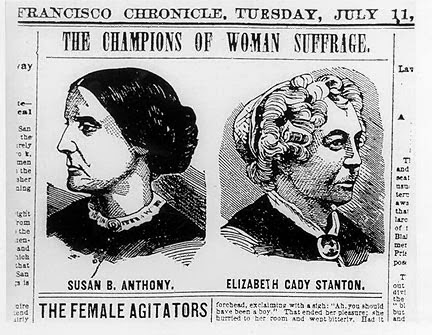
Susan B. Anthony recognized that without the right to vote women would keep fighting the same battles for equality over and over again. She traveled many miles, giving hundreds of speeches, gathering thousands of signatures on petitions, and organizing suffragists, to press for women’s suffrage.
In 1872 Susan B. Anthony forced the issue. The newly added Fourteenth Amendment to the United States Constitution granted equal protection under the law, and defined citizens as anybody born or naturalized in the United States. The law was passed to protect freed black people in the aftermath of the Civil War. As a citizen, Susan B. Anthony decided to test the Amendment and went with her sisters and several other women to vote. After casting her ballot Susan B. Anthony wrote, “I have been and gone and done it…positively voted…” (p.424 Life & Work)
Soon after, a federal marshal showed up at Susan B. Anthony’s door to arrest her for wrongfully and willfully voting. She insisted the marshal arrest her properly and take her to the police station. In between her arrest and her trial, Susan B. Anthony spoke in all 28 towns and villages in Monroe County, New York, asking “Is it a crime for a U.S. citizen to vote?” At Susan B. Anthony’s trial, the judge ordered she be found guilty without deliberation, and fined her $100. She refused to pay. To avoid an appeal, the judge did not throw Susan B. Anthony in jail.
In 1875, the Supreme Court of the United States decided that women were indeed citizens but that citizens do not necessarily have the right to vote. It was up to the states to decide voting requirements beyond what was written in the Constitution. Southern states instituted poll taxes and literacy tests that, in addition to the threat of lynching, effectively kept poor black people from voting until the 1960s.
It would take more than fifty years for the 19th Amendment to pass, fourteen years after Susan B. Anthony died. Widely known as the Susan B. Anthony Amendment, “the right to vote shall not be denied on account of sex,” became the law of the land in 1920.
Click here for a link to Historic Speeches on Suffrage.
Abolitionist
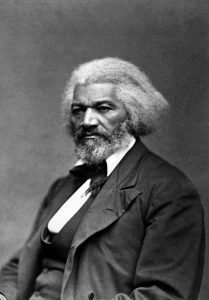
Susan B. Anthony was a Quaker. Quakers believed the inner light of God existed in every human. It did not matter if you were a man or woman, black or white, every soul was equal in the eyes of God. Not surprisingly, Quakers freed their slaves in the 1700s and many activists in the abolitionist and women’s rights movements were Quakers.
When the Anthony family moved to Rochester in 1845, their farmhouse became a meeting place for abolitionists, including Frederick Douglass and William Lloyd Garrison. In 1856, Susan B. Anthony served as an American Anti-Slavery Society agent, arranging meetings, making speeches, putting up posters and distributing leaflets. When Susan B. Anthony encountered hostile mobs, armed threats, and had things thrown at her, she did not quit. Even when her image was hung in effigy and dragged through the streets of Syracuse, she kept on working for abolition.
During the Civil War, Susan B. Anthony and fellow reformer, Elizabeth Cady Stanton, put their women’s rights work on hold to organize the Woman’s Loyal League. The league gathered thousands of petitions to outlaw slavery. After the 13th Amendment passed, making slavery unlawful, Susan B. Anthony and Elizabeth Cady thought the time had finally come for women’s suffrage. They demanded new laws protect everyone’s right to vote; black or white, man or woman. They were disappointed and disillusioned when women were excluded from voting rights under the newly adopted 14th and 15th Amendments.
Click here for a link to Historic Speeches on Abolition.
Women’s Rights
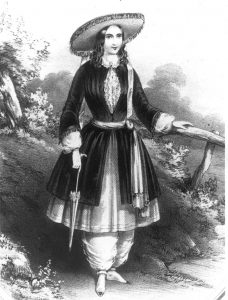
Susan B. Anthony advocated dress reform for women. She cut her hair and wore the bloomer costume for a year before ridicule convinced her that this radical dress detracted from the other causes she supported.
In the 1840s, Anthony began to campaign for women’s property rights in New York state, speaking at meetings, collecting signatures for petitions, and lobbying the state legislature. In 1848, largely as the result of her efforts, the New York State Married Women’s Property Bill became law, allowing married women to own property, keep their own wages, and have custody of their children. Anthony and Elizabeth Cady Stanton campaigned for more liberal divorce laws in New York.
In 1869 Anthony persuaded the Workingwomen’s Association in New York to investigate the case of Hester Vaughn, a poor working woman accused of murdering her child born outside of wedlock. Vaughn was pardoned, and Anthony used the case to point out the different moral standards expected of men and women, and the need for women jurors to ensure a fair trial.
In 1875 she attacked the “social evil” of prostitution in a speech in Chicago, calling for equality in marriage, in the workplace, and at the ballot box to eliminate the need for women to go on the streets. Click here to view a PDF of an 1895 speech on similar topics.
Women must have a purse of her own, & how can this be, so long as the wife is denied the right of her individual & joint earnings. Reflections like these, caused me to see & really feel that there was not true freedom for woman without the possession of all her property rights . . . This demand must be made by petitions to the Legislature . . .
—Susan B. Anthony, Diary, November 11, 1853
Temperance Worker

In the 19th Century, alcohol was plentiful and potent. The prevalence of alcoholism impacted women and children, particularly married women and children. They had no recourse when drunken husbands beat them or abandoned them.
In the early 19th Century, divorce was not allowed. A married woman could not move out and rent an apartment. She could not hold property in her own name. She could not sign contracts or open a bank account. She did not have any rights to custody of the children. By law, anything that she possessed or earned was her husband’s property.
Many of the social problems were attributed to the prevalence of alcohol: crime, licentiousness, crude and vulgar behavior, gambling, and the ability to stay gainfully employed. When men organized as the “Sons of Temperance,” women we not allowed to join, so they started an auxiliary organization called the Daughters Union, and later the “Daughters of Temperance.”
Because curbing alcohol abuse concerned the welfare of women and children, temperance work was considered an acceptable womanly endeavor. The tactic used to address the problem was “moral suasion.” By teaching people about the dangers and effects of alcohol abuse, temperance workers believed they could make it culturally unacceptable to imbibe.
Susan B. Anthony’s first “cause” was temperance, and it prepared her for other social reforms.
Susan B. Anthony made her first public speech at an 1848 temperance Union supper. She helped gather 28,000 signatures on a petition calling the state legislature to pass a law limiting the the sale of liquor. It was rejected because it contained the signatures of women and children. In the eyes of the legislature, those signatures did not count. Susan B. Anthony quickly recognized that women would have more influence on laws, policies, and politicians, if they had the power to vote.
At a joint meeting of the “Sons of Temperance” and the “Daughters of Temperance,” Susan B. Anthony rose to speak to the assembly, and the chair told her that the women were there to “listen and learn.” Women were passionately dedicated to the cause, but they were dismissed as insignificant.
Working for temperance led Susan B. Anthony to become an advocate for women’s rights. After helping to organize the Woman’s State Temperance Society (New York), Susan B. Anthony and others were criticized from within the organization for their focus on women’s rights–especially married women’s rights and the right to divorce. Susan B. Anthony and other “radicals” eventually resigned.
After the Civil War, the Women’s Christian Temperance Union began to take off, growing membership much faster than the woman’s suffrage movement. By this time, their agenda was to make the sale of alcohol illegal, rather than to change attitudes about it. In the 1870s, Susan B. Anthony reached out to the Women’s Christian Temperance Union to encourage them to join the suffrage movement. She refused to support Prohibition, but she argued that temperance women would be more effective at changing laws and policies if they had the power of the vote.
Woman must not depend upon the protection of man, but must be taught to protect herself.”
—Speech in San Francisco (July 1871)
Labor Activist
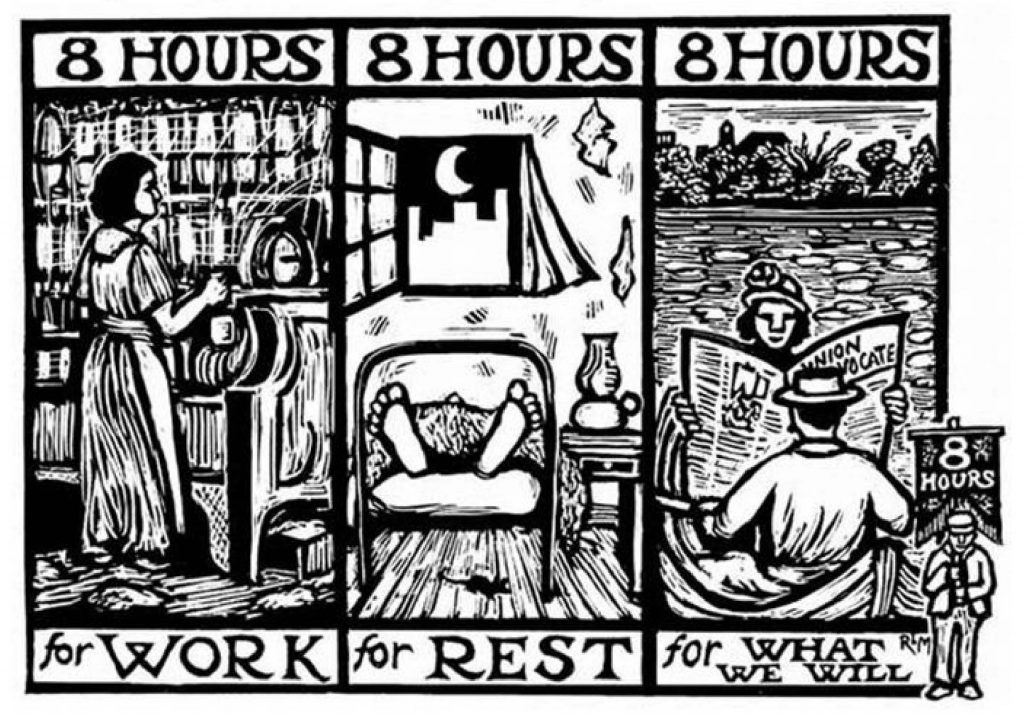
Susan B. Anthony advocated an eight-hour work day and equal pay for equal work. When male teachers complained that teachers were not respected, Susan B. Anthony fired back, “so long as society says a women has not brains enough to be a doctor, lawyer or minister, but has plenty to be a teacher, every man of you who condescends to teach, tacitly admits before all Israel and the sun that he has no more brains than a woman.” (Life & Work, 101)
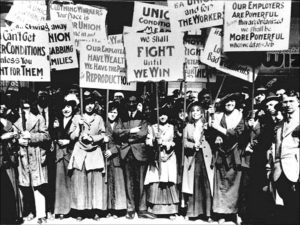
As head of the Workingwoman’s Association, Susan B. Anthony campaigned to open professions to women, and taught working women how to organize themselves on the basis of equal rights.
“Make up your minds to take the ‘lean’ with the ‘fat,’” she counseled, “and be early and late at the case precisely as men are. I do not demand equal pay for any women save those who do equal work in value. Scorn to be coddled by your employers; make them understand that you are in their services as workers, not as women.” (Life & Work, 308)
Educational Reformer
Both sexes eat, sleep, hate,
love and desire alike.
Everything which relates to the operations
of the mind is common in both sexes…
If they are allowed
to attend picnics together, and balls,
and dancing schools,
and the opera it certainly
will not injure them to use
chalk at the same blackboard.”
—Susan B. Anthony, Speech, 1856
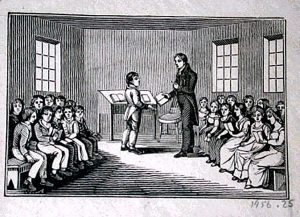
When the Anthony family lost their business due to the 1837 depression, Susan B. Anthony began teaching to support herself. By 1846, 26-year-old Susan B. Anthony had worked her way up to headmistress of the Women’s Academy, in Canajoharie N.Y. Effective and respected, she never grew accustomed to earning three-quarters less pay than males teachers.
At the 1853 state teacher’s convention, Susan B. Anthony spoke up to admit women into professions and for better pay for women teachers. Her demand to speak in public, as a woman, was shocking, not just to the men, but also many women, who yelled at her to “sit down” and “get out.” (p.103 Life & Work)
By 1859, it was no longer a novelty to hear Susan B. Anthony address the state teacher’s convention, but her arguments still were. She insisted that boys and girls be educated together, claiming there was no difference between the minds of men and women.
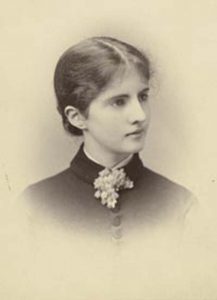
In the 1890s, Anthony organized a committee to raise $50,000 to ensure the admittance of women into the University of Rochester. In a last-minute effort to meet the deadline, she pledged the cash value of her life insurance policy. The University was forced to make good on its promise, admitting women for the first time in 1900.
Publisher
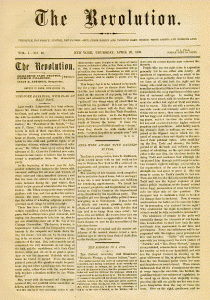
Susan B. Anthony, with Elizabeth Cady Stanton and Parker Pillsbury, began a newspaper called The Revolution. The paper’s masthead boldly declared, “Men Their Rights and Nothing More, Women their Rights and Nothing Less.”
Many articles in The Revolution argued that women, black and white, should be treated equally to men, but some also denounced giving uneducated black and Irish men the right to vote when educated women could not. The Woman’s Suffrage movement split in half, one side supporting black male suffrage first, the other led by Anthony and Stanton, called for universal suffrage immediately.
Nursing Advocate
Western New York State was the home of nursing visionaries who shaped the profession and promoted the importance of nursing to families, the health of the population, and the care of those most in need. Susan B. Anthony’s reform work and the development of the nursing profession intersected at many points, fueling a symbiotic relationship that furthered each cause.
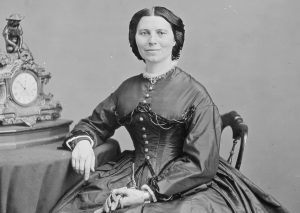
Clara Barton organized nurses during the American Civil War (1861–1865) and established the American Red Cross in 1881. She met Susan B. Anthony after the Civil War and joined her working for women’s rights. Barton frequently visited Susan and Mary Anthony at their home, and Barton spoke at many suffrage conventions. In turn, in 1902, Susan B. Anthony was the keynote speaker at the New York State nurses convention, advocating for professional education and the licensing of nurses. Read Clara Barton’s speech on woman suffrage.
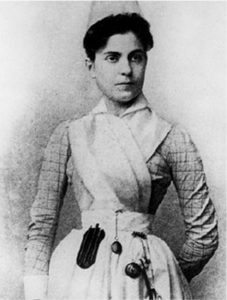
Rochester, NY was also the home of Lillian Wald (1867–1940), a nurse who transformed the care of the poor, immigrants, women, and children by originating the concept of public health and school nursing in the United States.
Read about Susan B. Anthony’s experiences nursing her family members.
Read about Rochester, NY’s role in the nursing profession.
Read about the nurses who cared for Susan B. Anthony in her last illness.
Want to share the story of Susan B. Anthony and Nursing?
Become a Nursing Friend of the National Susan B. Anthony Museum & House!
Susan B. Anthony Dollar
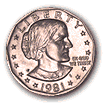 Susan B. Anthony was the first woman to be honored by having her likeness appear on a circulating United States coin. In 1978, President Jimmy Carter signed the Susan B. Anthony Dollar Coin Act into law (Public Law 95-447). This law amended the Coinage Act of 1965, changing the size, weight, and design of the one-dollar coin. On July 2, 1979, the U. S. Mint officially released the Susan B. Anthony coin in Rochester, NY, the home of Susan B. Anthony during the most politically active years of her life. In 1979, 757,813,744 coins were produced. Additional coins were dated 1980, 1981 (numanistic items only), and 1999. Ultimately, the United States Mint produced 888,842,452 Susan B. Anthony coins for circulation.
In 1997, Congress passed the United States $1 Coin Act (Public Law 104-124, Sec. 4), replacing the Susan B. Anthony dollar with the golden dollar coin. The golden color of this new coin, combined with a smoother edge and wider border, helps to more easily differentiate it from a quarter. The act also authorized the Secretary of Treasury to continue to mint Susan B. Anthony coins until such time as the production of new golden coins was ready. In 1999, the final 41,368,000 Susan B. Anthony coins were minted. The coins continue in circulation today.
(Photograph courtesy of the U.S. Mint)
Alligator Purse
More Than a Purse
Susan B. Anthony’s “purse” has gotten a lot of press. Sometimes, people are referring to her famous quote about a woman’s financial independence:
Woman must have a purse of her own, & how can this be, so long as the wife is denied the right to her individual and joint earnings. Reflections like these, caused me to see and really feel that there was no true freedom for woman without the possession of all her property rights. . . This demand must be made by Petitions to the Legislature. . .
—Susan B. Anthony, Diary, November, 1853
Susan B. Anthony worked passionately to raise awareness about the ways in which women were denied financial opportunity and worked to change the laws in New York state.
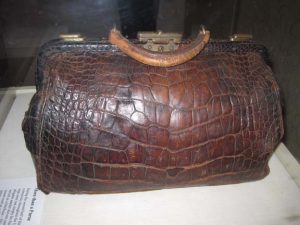
At other times, people are referring to the “alligator purse” that became a symbol for the woman and for the voting rights she championed We have that purse here at the Anthony Museum. It certainly wasn’t a fashion item! It looks more like a doctor’s satchel (the style was called a “club bag”), and it probably served more like a sturdy briefcase than a fashion accessory.
“Vote!” Said the Lady with the Alligator Purse
You may recognize this children’s jump-rope rhyme that was recorded by the press when Anthony was campaigning for suffrage in California:
Miss Lulu had a baby, she called him tiny Tim.
She put him in the bathtub, to see if he could swim.
He drank up all the water! He ate up all the soap!
He tried to swallow the bathtub, but it wouldn’t go down his throat!!
Call for the doctor!
Call for the nurse!
Call for the lady with the alligator purse!
“Mumps!” said the doctor. “Measles!” said the nurse.
“Vote!!” said the lady with the alligator purse!!
An updated, fashionable replica of Anthony’s purse is for sale in our Museum Shop.
Susan B. Anthony & Race
The question of Susan B. Anthony’s relationship to race and racism is a complex one. In recent years, some scholars have begun to take issue with her racial politics, going so far as to call her a racist. Rather than attempt to determine what was in the heart of a woman born in the 19th Century, we at the Anthony Museum try to learn lessons about race based on Anthony’s words and actions. Her decades of work as an abolitionist and her longtime collaboration with Frederick Douglass can serve as a model to follow for antiracist activism. At the same time, she cannot be absolved of responsibility for comments that reinforced racist stereotypes, or for her tolerance of the racism espoused by figures like George Francis Train, who provided funding for her newspaper, The Revolution.
There is much to learn from Susan B. Anthony, and we continue to do so. We hope that you’ll join us in this effort. To dig further into this question, please explore the following resources:
Historian and Scholar Ann D. Gordon Addresses the Question, “Was Susan B. Anthony a Racist?”
If Susan B. Anthony Was a Racist by Linda Lopata, former Director of Interpretation and Visitor Services
In Memory of George Floyd by Deborah L. Hughes, President & CEO
Resources for Teachers
Resources for Further Research
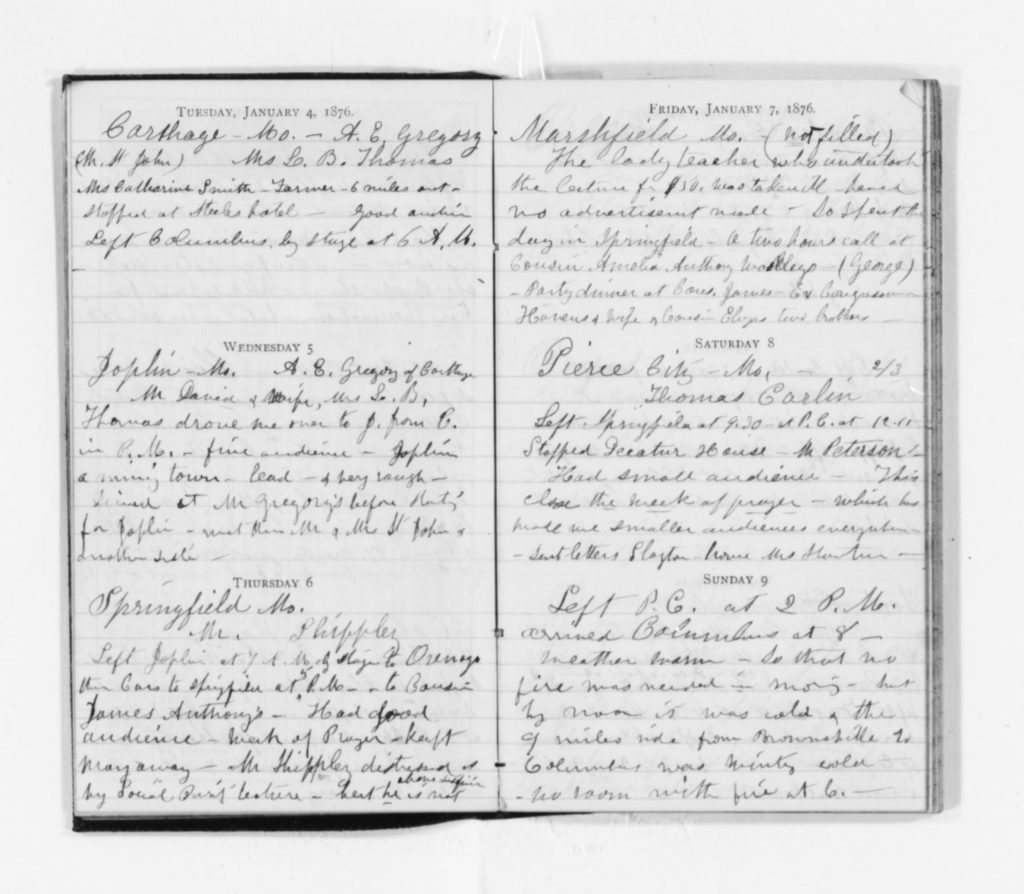
Susan B. Anthony’s diary; photo from the Library of Congress, Susan B. Anthony Collection
Library of Congress, Susan B. Anthony Collection
Susan B. Anthony Letters Collection, Rochester Public Library, Local History Division
National Women’s History Museum
Carrie Chapman Catt’s Childhood Home in Iowa
11th Berkshire Conference on the History of Women
National Women’s History Project
Places Where Women Made History: A National Register of Historic Places
National Women’s Hall of Fame in Seneca Falls, New York