
A personal reflection by Anne C. Coon
On January 1, 2020, Deborah Hughes, President & CEO of the National Susan B. Anthony Museum & House, along with Anthony Museum volunteers Emily Jones and Anne Coon, marched as outwalkers in the 2020 Rose Parade. They were among the 98 women and two men accompanying the Pasadena Celebrates 2020 float “Years of Hope, Years of Courage” in honor of the 100th anniversary of the 19th Amendment.
The originator of the idea for the “Years of Hope, Years of Courage” float and founder of Pasadena Celebrates 2020, a non-profit dedicated to honoring the suffrage centennial, was former Rochesterian Nan Johnson. Nan is a retired professor, co-founder of the Friends of Women’s Rights National Historical Park in Seneca Falls, and Founding Director of the Susan B. Anthony Center for Women’s Leadership at the University of Rochester. On the float itself, the riders included descendents and relatives of Frederick Douglass, Susan B. Anthony, Elizabeth Cady Stanton, Ida B. Wells, and Harriet Tubman. There were also highly accomplished women leaders, authors, scientists, and activists, including Dolores Huerta, Johnnetta Cole, and Lynnette Grey Bull.
I’ve always loved parades, from watching Memorial Day parades as a kid, to marching in the Fireman’s Band as a teenager (slamming the cymbals, since there was little need for my flute playing), and now, turning on the Macy’s and Rose Parades as part of my annual holiday rituals. When I was presented with the opportunity to march in the 2020 Rose Parade in Pasadena as an “outwalker” accompanying the float “Years of Hope, Years of Courage,” I hesitated for about a nanosecond. After the application and acceptance emails, what followed were several months of anticipation and details.
When the costume requirements arrived, I approached my friend Mary Ellen Hill, owner and designer/seamstress at Bespoke Designs, with the challenge of creating an Edwardian walking suit with some 21st century flourishes. There were forms and waivers to sign, photos and bios to send, and often, throughout the process, I conferred with my fellow outwalkers, Deborah Hughes and Emily Jones, who were also representing the National Susan B. Anthony Museum & House. We talked about travel plans (What’s the best airport for getting to Pasadena?), costume requirements (Did it really have to be a long skirt? How about trousers?), and how to manage the mundane but critical details of what it would take to get up and be parade-ready by 3 a.m., not to mention the demands of the 5 and ½ mile, no-rest-stop parade route.
Despite all the planning, the speculation, and the talk, nothing could have prepared me for the experience of marching in the Rose Parade. As soon as the one hundred outwalkers were taken by bus to the judging location the day before the parade, it was clear that wherever we came from, whatever state or organization we were representing, however we personally identified with the struggle for women’s suffrage, we were all in it, and all in it together.
With humor, and kindness, and a genuine sense of sisterhood, we soon formed a group. We were a team, a band of (almost entirely) women. We practiced getting our strides in synch—not easy when wearing a long skirt and, in many cases, also carrying a sign—especially on the broad turns that the float and ten rows of walkers would need to execute. We were instructed to hold hands on those turns, to increase the likelihood of our staying more or less straight across the rows. So we practiced some more.
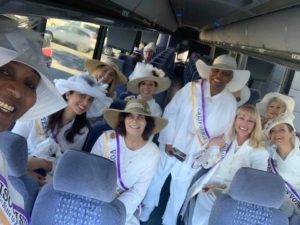
After hours of standing around, having our photos taken as a group, and again in many smaller sub-groups, we were packed off to take the buses back to our hotels, celebrate New Year’s Eve, and prepare ourselves for a very quick night’s sleep and pre-dawn wake-up.
The morning of January 1, 2020 started out chilly and clear in Pasadena. We could see the moon and the lights of the Goodyear Blimp from the bus windows as we made our way from the hotel to our staging location. Our “Ambassadors”—women assigned groups of ten outwalkers apiece to keep track of and if need be, help with problems—handed out granola bars and encouraged us to stay on the bus and keep warm before it was time to line up. So we sat on the dark bus and waited, everyone surprisingly quiet. Two local yoga instructors came aboard to demonstrate some stretches.
Shortly after the sun rose, we were shepherded off the bus, a little stiff but very excited. To get to our position, we walked along the sidewalks of a still-sleepy Pasadena neighborhood. If the residents who were out walking their dogs were shocked to see a stream of women in white striding along in two’s and three’s in the early dawn, they didn’t let on. (I bet that over the years they have observed all kinds of costumes passing under the streetlights in the hours just before the parade).
The “Years of Hope, Years of Courage” float was located just behind the Royal Court float and ahead of the Mayor of Pasadena, who was riding in a carriage pulled by a magnificent eight-hitch team of Clydesdales. As we and other marchers, floats, and bands were being slotted into position, checked for photo identification one last time, and given “participant” wrist bands, crowds were growing on either side of the street.
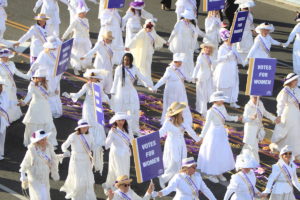 By this time, we had gotten to know the other marchers in our rows pretty well. Near me, there was a young woman who had been sponsored to participate in the march by a Pasadena professional women’s group. She was hoping to spot her friends who planned to be watching near the Urban Outfitters store. Another woman near me had made her costume herself, meticulously modeling it on a Suffragist photo. Sewn of white wool, it was a remarkable period replica, and with her antique necklace and eyeglasses, she was all ready to go!
Anyone who watched the parade coverage probably already knows about the dramatic moment that marked its start at 8 a.m. when United States Air Force Lt. Col. Nicola Polidor made history as the first female pilot ever to fly the B2 Stealth bomber over the opening of the parade. Looking up at the passage of this dark, strangely-shaped plane, the crowd drew a collective breath of anticipation. And then, gradually, we were off, unit by unit, stepping out and making our way toward the turn onto Colorado Boulevard, as we passed thousands of men, women, and children, many of whom had camped out on the sidewalks overnight to secure prime viewing spots.
And here’s the part that is so unforgettable: as parade viewers caught sight of our float, with its huge Statue of Liberty, its diverse cadre of float riders— descendents and relatives of Abolitionist and Suffragist leaders, as well as contemporary women visionaries and role models from many sectors, NASA to AAUW to the Girl Scouts—they began to cheer. Then came row upon row of women walking behind, carrying signs demanding “Votes for Women,” in a powerful re-creation of images seen in photographs from a hundred years ago. They cheered even louder. And waved. And cried.
The streets we passed along were narrow enough to make the turns a challenge for the gigantic float. They were also narrow enough that we could make eye contact. We could see the details of faces, the thumbs-up and peace signs. We could see and feel the sense of connection the float created. For a few moments, the massive statue and those accompanying her were telling the story of everyone in the audience, women and men alike, regardless of culture, generation, or language.
For women in particular, there was a palpable moment of recognition and acknowledgement. Women waved back to us from open windows and balconies several stories above the street and from crowded family groupings at the curb, where they were surrounded by men and children. Several times, I spotted individual women standing by themselves, away from the crowd. When the float and its columns of marchers came into view, they smiled, cheered, and raised both arms, in an affirming, “yes!”
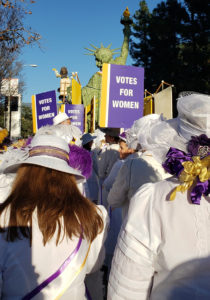 The float “Years of Hope, Years of Courage” was conceived as a celebration, a visible way to honor those who had dedicated their lives to securing the vote for women. Unique among other splendid floats produced by companies such as Chipotle Mexican Grill, Trader Joe’s, and Farmers Insurance, the “Years of Hope, Years of Courage” float was not focused on a product or a service; instead, it celebrated a fundamental element of our democracy. It was a glorious physical manifestation of something we need to honor and actively exercise: our right to vote.
I am very grateful to have had the opportunity to participate in the Rose Parade and to have represented the National Susan B. Anthony Museum & House. As those of us involved in planning for 2020 at the Anthony Museum look forward to this year’s celebrations and programs, I hope we, too, can generate the sense of connection and commitment embodied in “Years of Hope, Years of Courage.”
And there’s one last thing. When I talk to people who watched the parade, they frequently describe their own reactions. More than one has said, “I cried when you all held hands.”