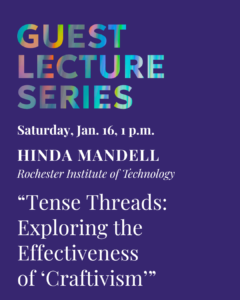
Tense Threads: Exploring the Effectiveness of ‘Craftivism’ From Suffragists to Social Media

Hinda Mandell, Rochester Institute of Technology “Tense Threads: Exploring the Effectiveness of ‘Craftivism’ From Suffragists to Social Media”

What is ‘Craftivism’ as a contemporary force, and what are its historic threads? This talk will start in the present day and will share examples of craft-based political actions on issues ranging from fighting against gender violence, immigration hostilities and climate degradation. We will then travel back in time to explain its antecedents, as well as tensions in the Suffragist movement relating to the utility of domestic craftwork. Participants are welcome to bring craft works-in-progress to share and work on during the talk.

Hinda Mandell is a professor in the School of Communication at RIT in New York. Mandell is editor of Global Craftivism since the Pussyhats: Handcraft Responses to Violence, War, Illness and Isolation (Bloomsbury 2026); author of Crafting Choice: Abortion Politics and Handwork in the U.S. (Bloomsbury 2026); editor Crafting Dissent: Handicraft as Protest from the American Revolution to the Pussyhats (Rowman & Littlefield, 2019); co-curator and co-editor of Crafting Democracy: Fiber Arts and Activism (RIT Press, 2019); and a co-editor of Nasty Women and Bad Hombres: Gender and Race in the 2016 US Presidential Election (University of Rochester Press, 2018). Since 2017, she has organized maker interventions on issues of social reform tied to geographic place reaching 2,000 craft participants. She’s been interviewed by The New York Times and The Associated Press, among other global outlets, on the importance of making objects by hand. She is on Instagram: @crochetactivism.

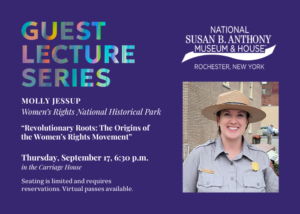
Revolutionary Roots: The Origins of the Women’s Rights Movement

The 1848 Women’s Rights Convention in Seneca Falls, New York, ignited a social movement for civil rights, human rights, and equality that challenged the traditional place of women in American society. Rooted in abolitionist activism, Quaker reform efforts, and grassroots organizing, the convention established a framework for what would become the women’s rights movement in the United States. It also marked the beginning of a long campaign to achieve equal rights and expand women’s role in American public life.

Molly Jessup is the acting Interpretation & Education manager at the Women’s Rights National Historical Park and the Harriet Tubman National Historical Park, part of the National Park Service.

“Racism and Anti-Racism: Some Lessons from Susan B.”

Join us for our Guest Lecture in November 2025, as Deborah L. Hughes, President & CEO, National Susan B. Anthony Museum, & House explores “Racism and Anti-Racism: Some Lessons from Susan B.” Attend in person, or virtually. For reservations and more information about this presentation and our Guest Lecture series, visit Guest Lecture Series

How Indigenous Women Championed Suffrage

Pictured: Bark Longhouse at Ganondagan State Historic Site in Victor, NY. Special thanks to the staff at Ganondagan for their incredibly informative tour and resources on this topic. 

While many point to the Seneca Falls Convention and its female abolitionists as the birth of the women’s rights movement here in New York State, there is a long history of women’s equality that predates European presence in North America. 

The Haudenosaunee (“People of the Longhouse”) are a democratic coalition of Six Nations: Seneca, Cayuga, Onondaga, Oneida, Mohawk, and later, Tuscarora, who put an end to a period of war and ushered in an era of peace and prosperity for its people. It became the longest running recorded democracy in history, inviting all to participate, regardless of gender. Under the Haudenosaunee government, Clan Mothers represented their clans (a group of extended family members) and gained incredible respect by listening carefully  to the voice of their community and bringing those needs to the Hoyaneh (male leader of a clan). Clan Mothers were responsible for appointing Hoyaneh, but instead of choosing warriors, they consistently chose men who had never killed in battle. If this man proved to be an irresponsible leader, this council of women also had the power to remove him from office. These wise women know the young men of their tribe well, and are careful to choose a Hoyaneh that will represent his people well in the broader Haudenosaunee government.

Women’s roles were respected in the home, as well. Because bloodlines were (and still are) traced through the mother, not the father, children inherit their mother’s clan name. When a couple married, the man would leave his tribe/family to live with his new wife and her family, sharing child rearing duties with the whole community*. In the case of divorce, which was openly available to women, children stayed with the mother’s clan and the ex-husband was sent back to his parents. Possibly the most telling sign of the happy, healthy, female community during this time was the rarity of assault. Family groups practiced a very open style of living in longhouses, which prevented secrecy and encouraged strong community bonds. The recorded cases of sexual misconduct that we can study from this time were punished severely, in accordance with the strong religious and social values the crime violated. Overall, history shows us that Haudenosaunee women enjoyed peace, safety, and social respect. While European-American women in the 1800’s were told to hold their tongue, obey their patriarch, and surrender their income and property, Indigenous women were encouraged to voice their opinions, lead a household, and manage resources. It is a model that early suffragists found absolutely inspiring.

Haudenosaunee women were happy to teach their lifestyle to suffragists like Matilda Joslyn Gage, an early and outspoken proponent of Indigenous life as the premier model for the suffrage movement. Gage fostered a relationship with local tribes throughout her life and took what she learned back to her own community. Although most suffragists dismissed Gage as a radical, shrewd strategists like Susan B. Anthony and Lucretia Mott deeply admired the harmony and independence of female life in Haudenosaunee tribes, mirroring that system in their own goals for the women’s right movement. In democracy and equality, the United States owes so much to the teachings of First Nations People.

* Many sources reveal that married men were still active in the lives of their birth family, including helping care for their sisters’ children, etc.

Monday Lecture Series – October 2022

October 3, 2022: Joanna Scutts, author of The Extra Woman, and has written for the New York Times, Washington Post, New Yorker, and the Paris Review – Topic: HOTBED: Bohemian Greenwich Village and the Secret Club that Sparked Modern Feminism

 HOTBED Bohemian Greenwich Village and the Secret Club that Sparked Modern Feminism 

by Joanna Scutts 

Deep in the heart of New York City, nearly a decade before the 19th Amendment granted women the right to vote, a revolution began. Some of the most outspoken and ambitious female figures of their time—from artists and journalists to lawyers, social workers, and scientists—gathered in Greenwich Village for the first meeting of “Heterodoxy,” a collective of visionary women whose imaginations created not only a community, but a movement for gender equality. 

In HOTBED: Bohemian Greenwich Village and the Secret Club that Sparked Modern Feminism (Seal Press; June 7, 2022), Joanna Scutts employs her training as a historian and literary critic to rescue the stories of these women and their extraordinary friendships. Even though Heterodoxy members kept no written records of their secret meetings, she navigates the wealth of information they left behind—memoirs, plays, poems, novels, lectures, interviews, and even film appearances—to compose a probing history of feminism’s origins, from the words of some of its earliest pioneers. 


REGISTRATION INFORMATION

Individual virtual lecture is available for $30 each with a limited number of viewers.

Click HERE to register for  an individual lecture

Susan B. Anthony vs. The List

Every election cycle, the National Susan B. Anthony Museum & House is barraged with inquiries about the Susan B. Anthony List*.  “The List” is a PAC, a political action committee organized for the purpose of raising and spending money to elect and defeat candidates. We have no affiliation with “The List”, and we find their use of Susan B. Anthony’s name in support of their agenda to be misleading, deceptive, and damaging to Anthony’s legacy.

For decades, “The List” has been supporting candidates who promise to: 1. Defund Planned Parenthood, 2. Appoint only “pro-life” judges, and 3. Support overturning Roe v. Wade.

In the past, we have responded to inquiries about “The List” by clarifying the historical record about what Susan B. Anthony said or didn’t say about abortion (she said very little). Our website contains several articles that cover this in depth. (see below)

However, with the recent leak of the draft Supreme Court opinion in regard to Roe v. Wade, “The List” is getting media attention as they anticipate a victory for their anti-woman, anti-democracy agenda. They proclaim in their mission statement: “If Roe is indeed overturned, our job will be to build consensus for the strongest protections possible for unborn children and women in every legislature and in Congress.” 

But Roe v. Wade is not just about abortion access or reproductive choice; that is another deception. 

What is at stake is perhaps the most essential of our inalienable human rights: the right of an individual to make critical decisions about her (or his) own physical body in the pursuit of life, liberty and happiness. Susan B. Anthony, in her own words, stood for “woman’s right to control of her own person.”

If this right is compromised so profoundly, all other human rights are fragile: freedom of  religion, freedom of speech, freedom of assembly, and even the freedom to elect a government of the people, by the people, for ALL the people. Susan B. Anthony fought her whole life to secure these inalienable rights, and this fight is as relevant as ever.

To suggest that Susan B. Anthony would support government intervention in a woman’s decision about a pregnancy is abhorrent. To associate Susan B. Anthony’s name with any action that would criminalize a woman’s right to make decisions affecting her body, health, and welfare is a bizarre and dangerous distortion of Anthony’s life and work. 

As the organization that has preserved Susan B. Anthony’s National Historic Landmark home and interpreted her life and work for more than 75 years, the National Susan B. Anthony Museum & House goes on record in opposition to The List and their misappropriation of her name. We stand with Susan B. Anthony for a woman’s right to control of her own person.

Deborah L. Hughes
President & CEO
National Susan B. Anthony Museum & House

*The Susan B. Anthony List rebranded as Susan B. Anthony Pro-Life America in June 2022.

Pertinent Website Articles:

https://susanb.org/misrepresenting-susan-b-anthony-on-abortion/

https://susanb.org/were-not-that-susan-b-anthony/

https://susanb.org/anthony-museum-raises-concern-over-continued-misuse-of-anthonys-name-and-legacy/

https://susanb.org/rochester-icon-defamed/

Wreath Hanging Ceremony

National Susan B. Anthony Museum & House Commemorates
Susan B. Anthony’s Death and Legacy

The National Susan B. Anthony Museum & House will host a ceremonial wreath hanging on the front steps of 17 Madison Street, the National Historic Landmark that was Susan B. Anthony’s home and headquarters, on Saturday, March 13, 2022 at 11:00 a.m.

The brief ceremony commemorates the 116th anniversary of Susan B. Anthony’s death and will include remarks by Anthony Museum President & CEO, Deborah L. Hughes.

Susan B. Anthony is as relevant as ever, even 115 years after her death. Come join us as we celebrate the life and accomplishments of this remarkable woman who called Rochester her home.

This event is free and open to the public.